
Yes — we ship Teslas and other electric cars on open and enclosed carriers across the 48 contiguous states. Your EV only needs enough charge to drive on and off the trailer. An EV that doesn’t run can ship too, loaded with a winch. Enter your route and vehicle, and you’ll see your price in about a minute.
How an electric car rides on a carrier
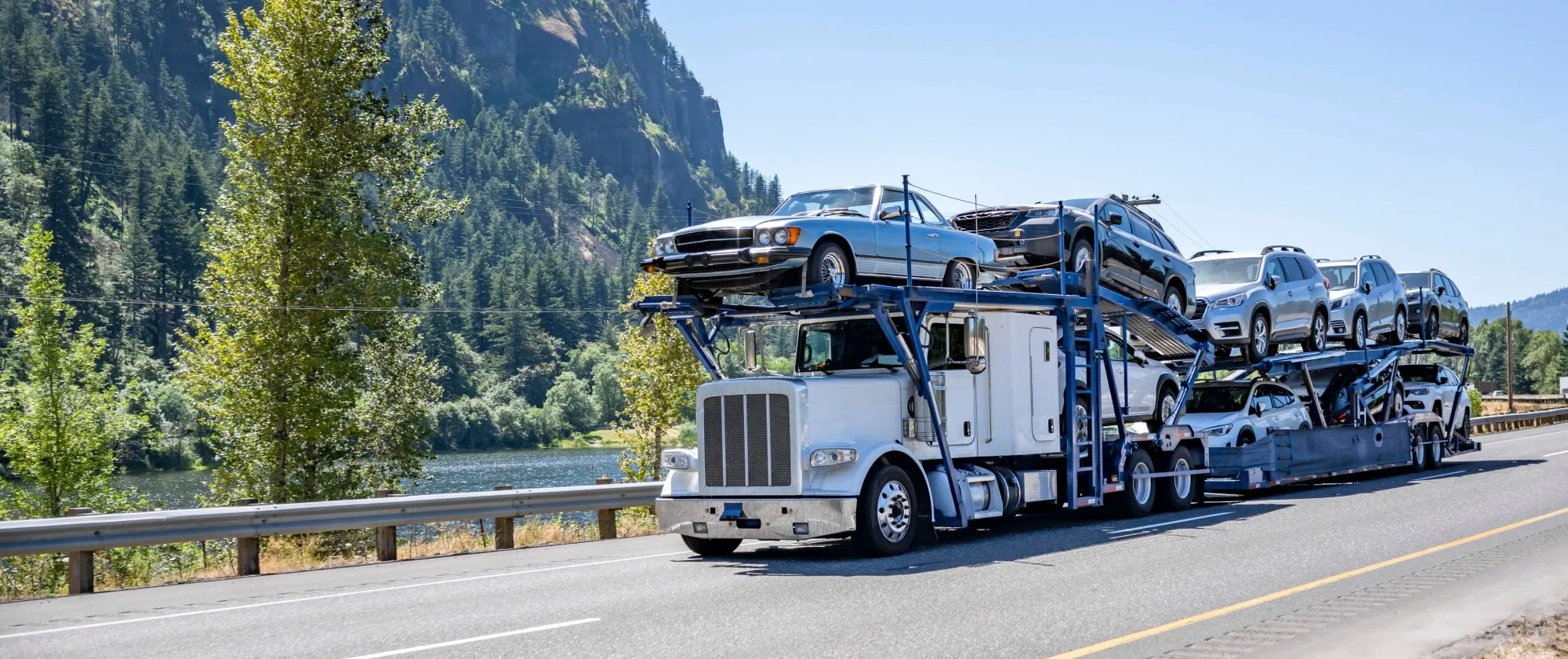
An EV ships on the same car carriers as any other car. The driver drives it onto the trailer and the carrier secures it there, and it rides the whole way with its wheels on the trailer deck, not the road.
That matters more for an EV than for a gas car. The makers are clear that their electric cars shouldn’t move with the wheels turning on the ground:
- Tesla says to always transport the car with all four tires off the ground, because the motors generate power when the wheels spin. It recommends a flatbed or a comparable transport vehicle, and securing the car with an eight-point tie-down on the tires — not over body panels or through the wheels. (Tesla: Instructions for Transporters)
- Ford says towing a Mustang Mach-E requires all wheels off the ground, using wheel-lift and dolly or flatbed equipment, and never a sling belt. (2023 Mustang Mach-E Owner’s Manual, “Transporting the Vehicle”)
- Rivian says to transport the R1T and R1S only on a flatbed, because towing with any wheels on the ground can cause serious damage and overheating. (Rivian R1T + R1S Tow Operator Guide)
If your EV has its own instructions for transporters, they’re in the owner’s manual — the driver can follow them at pickup.
How much charge does it need?
Not much. The car needs enough charge to drive onto the trailer at pickup and off it at delivery, under its own power.
Leave a little margin, though. Tesla says a parked Tesla typically uses about 1% of its charge a day, and features like Sentry Mode can use more (Tesla: Range Tips). The car may sit on the truck for several days, so don’t hand it over close to empty.
Preparing your EV for pickup
- Give the driver a physical key. For a Tesla that’s a key card — your phone key stays with you. Tesla’s transport instructions need a key in the car: a key must be detected to put the car in Tow Mode, and a phone key or key card is needed to drive it again afterwards. For other makes, hand over a key fob.
- Turn off Sentry Mode and alarms. Sentry Mode uses energy while the car is parked, and an alarm that keeps going off on the truck can drain the battery. Turn them off before pickup, and back on when the car arrives.
- Unplug it. Tesla’s Tow Mode isn’t available while the car is connected to a charger. Take the charging cable and adapters with you, or pack them with your personal items: up to 100 lbs, in the trunk or below the window line; more only if your dispatcher confirms it in writing with the carrier (it may cost extra). Personal items travel at your own risk.
- Take out the toll tag. Toll agencies such as E-ZPass New Jersey say tags must be removed from a vehicle under tow, or the account may be charged for tolls along the way (E-ZPass NJ terms). Take the tag out or put it in its read-prevention bag.
- Tell us the exact model. Year, make, model and trim, and whether it runs — so we assign a carrier with the right equipment.
- Record its condition. Walk around the car with the driver and note any marks on the Bill of Lading. Take photos.
Open or enclosed?
Open transport is the standard for everyday cars, EVs included. Enclosed transport keeps the car inside a covered trailer, shielded from weather and road debris — a common choice for a new car, a high-value model or anything you want to arrive spotless. Enclosed is +$450 per vehicle — you’ll see your price after a quick contact step. More on enclosed auto transport.
If your car is worth more than $100,000, tell us before you book, so we look for a carrier with higher cargo insurance limits.
An EV that doesn’t run
An EV that won’t drive can still ship, the same way as any car that doesn’t run: it must roll, steer and brake, and the carrier pulls it on with a winch. Not running is +$150 per vehicle, shown in your price before you book. See shipping a car that doesn’t run.
The difference with an EV is the parking brake. To roll, it has to be released electronically:
- On a Tesla, that’s Tow Mode (Controls > Service > Towing). It needs low-voltage power and a key in the car. If the touchscreen can’t be used, Tesla says to load the car with self-loading dollies or tire skates.
- On a Rivian, it’s Park brake release (Settings > Vehicle > Service), which switches off again after 15 minutes. If the brake can’t be released, Rivian says to lift the rear wheels to load the car.
If your EV has no power at all, or its brakes are locked, call us first — it needs special arrangements. If it has been in a collision, tell us before you book: Tesla advises treating high-voltage components in a damaged car as energized until a professional has checked them.
What it costs
Your price depends on the distance between your two addresses, the vehicle and how it ships. Enter your route and your EV in the calculator and you’ll see your price in about a minute — after a quick contact step. Once you sign, Price Lock protects it: if the carrier’s rate goes up before pickup, we cover up to $200 per vehicle.
You don’t pay to get a quote or to book. After a carrier is assigned, a $150 deposit goes on your card — it’s part of your total. The rest is charged at pickup, or paid to the driver at delivery if you choose pay on delivery.
Who carries your car
On every load we verify the carrier: an SMS to their FMCSA phone, insurance from the agent, the driver’s location at pickup, and a VIN-plate check against the carrier’s insured vehicles. See how our verification works. Your car is covered by the assigned carrier’s cargo insurance, at least $100,000; ShiftHaul itself doesn’t insure vehicles. See insurance and claims.
Heading south for the winter, or moving? Our route guides cover Michigan to Florida, Ohio to Florida, Indiana to Florida and New York to Florida.
Get your price for your EV.